

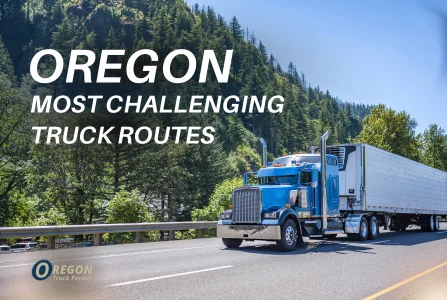
Oregon Mountain Passes for Commercial Trucks: Routes, Risks, and Preparation
 Published on: September 25, 2026
 Category:
Blog
Category:
Blog
A route that looks ordinary on the map can feel very different when 80,000 pounds of truck and freight starts climbing it. Oregon mountain passes can combine steep grades, long descents, sharp curves, snow, ice, fog, and changing visibility. Commercial trucks also need more room to slow down and more planning before entering difficult terrain. Southern Oregon’s I-5 corridor is a good example. ODOT describes its summits as the highest climbs and descents anywhere along I-5 between Canada and Mexico, with Siskiyou Summit reaching 4,310 feet near the California border. This guide focuses on the mountain-driving side of Oregon freight travel: difficult passes, truck preparation, chain requirements, grade management, and checking conditions before departure. For the bigger statewide routing picture, see our guide to the best Oregon truck routes.
Which Oregon Mountain Passes Are Most Challenging for Trucks?
Southern Oregon deserves particular attention from commercial drivers. ODOT describes the I-5 section between Canyonville and the California border as a series of five summits and valleys. These mountain sections have a history of commercial truck crashes on steep climbs and downgrades, especially during wet or winter weather. The challenge is not simply elevation. A truck can move from a valley into snow, fog, freezing pavement, or reduced visibility in a relatively short distance. Drivers also have to manage changing grades while maintaining safe speeds around other traffic.
Why Is Siskiyou Summit Difficult for Trucks?
Siskiyou Summit sits on I-5 just north of the Oregon-California border and reaches approximately 4,310 feet, making it the highest point on the entire Interstate 5 corridor. That elevation comes with steep approaches and lengthy downgrades. ODOT has repeatedly highlighted the summit as an area where changing weather and excessive speed can contribute to crashes and delays. The agency installed variable speed-limit and warning signs between the California border and Ashland that can respond to factors such as pavement traction, temperature, humidity, and visibility. For a heavy truck, the approach should begin before the steep section. Check the weather, know what the load weighs, identify the expected descent, and reduce speed before gravity decides to help.
What Should Drivers Know About Southern Oregon’s I-5 Summits?
Siskiyou gets most of the attention, but it is not the only mountain section on southern I-5. ODOT’s “I-5 roller coaster” guidance covers five summits between Canyonville and the California border and warns commercial drivers about the repeated pattern of climbs, valleys, and descents. That means clearing one summit does not mean the difficult part of the route is over. Drivers should check the entire southern Oregon corridor before departure rather than looking only at conditions at Siskiyou Summit. And during unstable weather, check again at a safe stop.
How Should Heavy Trucks Prepare for Mountain Pass Driving?
Mountain driving starts before the mountain. Route planning should consider the truck, trailer, load weight, expected grades, weather, and the conditions at higher elevations, not just the forecast at the pickup point. Heavy-haul guidance also emphasizes checking road grades, timing, vehicle condition, and load securement before entering difficult terrain. A sunny morning in the valley does not guarantee a dry summit.
How Do Road Grades Affect Heavy Trucks?
Road grades are normally shown as percentages. A 6% grade, for example, means the road gains or loses six feet of elevation for every 100 horizontal feet traveled. As the grade becomes steeper, a heavy vehicle places greater demands on its engine, transmission, braking system, and tires. Going uphill, the truck may need a lower gear and greater engine output. Going downhill, gravity is adding energy to the vehicle whether the driver wants it or not. That is why gear and speed decisions should happen before a descent. Entering too fast and then trying to resolve the problem with continuous service-brake use can increase brake heat and reduce the margin available to the driver.
What Should Drivers Check Before Leaving?
A pre-trip inspection becomes even more important before commercial truck mountain driving.
Pay particular attention to:
- Brake condition and responsiveness
- Tires and tire pressure
- Fluid levels
- Steering and lights
- Trailer connections
- Cargo securement
- Load distribution
Heavy-haul guidance notes that unbalanced or shifting loads can reduce stability through curves and recommends checking securement during the trip as appropriate.
The load that looked perfectly stable in a flat parking lot still has to remain stable while climbing, descending, braking, and cornering.
What Are Oregon’s Chain Requirements for Commercial Vehicles?
Oregon’s chain requirements depend on the vehicle and current road conditions. ODOT states that commercial vehicles over 10,000 pounds GVW must carry chains whenever road conditions may require their use or when Snow Zone signs are posted. Carrying chains and using chains are not the same requirement. Drivers may be required to carry them in anticipation of winter conditions, while roadside signs and current restrictions determine when they must actually be installed. When a sign requires chains on vehicles over 10,000 pounds GVW or on vehicles that are towing, applicable commercial vehicles must chain up according to Oregon’s placement requirements. The exact number and placement depend on the tractor and trailer configuration.
Where Are Chains Required in Oregon?
There is no permanent list where chains are always installed on every trip. The Oregon chain law for commercial vehicles applies statewide through Snow Zone signs, electronic message signs, and current road restrictions. ODOT recommends checking TripCheck before each trip for:
- Chain requirements
- Snow Zone notices
- Closures
- Emergency alerts
- Mountain-pass cameras
So if you are asking where chains are required in Oregon today, the answer comes from current signs and TripCheck conditions, not last week’s route plan. That is particularly important for Siskiyou Summit chain requirements. ODOT notes that conditional closures are frequent in winter on I-5 through Siskiyou Pass. Under severe conditions, Oregon may require chains more broadly than under ordinary winter restrictions. The same principle applies when checking Cabbage Hill chain requirements or I-84 Blue Mountain pass road conditions: review the current restriction for the route and vehicle combination.
How Should Truckers Chain Up Safely?
ODOT’s advice is refreshingly simple: Do not wait until the last possible moment. Drivers should use a safe, level location such as a designated chain-up area. ODOT also recommends wearing warm reflective clothing and positioning your body away from the travel lane while working. Practice matters too.
Installing chains for the first time on the shoulder, in the dark, while snow is blowing sideways is an unnecessarily difficult way to learn. ODOT recommends practicing before the trip and making sure the chains fit the vehicle.
How Should Truckers Drive Safely on Steep Grades?
Climbing and descending are two different problems. An uphill grade demands power and temperature management. A downhill grade demands speed and braking management. In both directions, sudden acceleration, aggressive braking, and last-second decisions make a difficult route even more challenging.
How Can Drivers Handle Steep Uphill Grades?
Choose an appropriate gear before the truck begins struggling. A lower gear can help the engine stay within a usable power range, while a steady approach reduces unnecessary shifting and acceleration. Heavy-haul guidance also recommends monitoring engine temperature during extended climbs and avoiding unnecessary speed changes that place additional demand on the powertrain. Expect slower speeds. A mountain pass is not the place to fight physics because dispatch gave you an optimistic ETA.
How Can Drivers Descend Mountain Passes Safely?
The most important speed decision is usually made at the top. Reduce speed before the descent, choose a suitable lower gear, and use available engine braking appropriately rather than depending entirely on the service brakes. Remain alert for curves, traffic, wet or icy pavement, changing visibility, and warning signs. ODOT’s Siskiyou guidance reinforces the same basic lesson: high speed combined with changing mountain conditions has repeatedly contributed to crashes and delays. Once a fully loaded truck has gained too much speed on a downgrade, the driver’s options become much less comfortable. Good mountain driving is mostly about preventing that situation from developing.
How Can Drivers Check Oregon Pass Conditions and Truck Facilities?
Before every mountain trip, open TripCheck. ODOT recommends the service to commercial drivers for current chain information, Snow Zone notices, closures, emergency alerts, and camera views of Oregon highways and mountain passes. The camera network includes highway locations across I-5, I-84, US 26, and other routes, allowing drivers and dispatchers to visually review pavement and visibility in addition to reading condition reports. When checking Oregon mountain pass road conditions, look at more than a single temperature reading.
Review:
- Oregon pass weather
- Current pavement conditions
- Chain controls
- Closures and incidents
- Visibility
- Commercial vehicle notices
- ODOT TripCheck cameras
- Conditions farther along the route
Road conditions can change after departure, so review updates during safe stops. TripCheck’s Trucking Center also identifies commercial truck facilities around the state. Relevant locations include:
- Ashland Port of Entry – I-5, Siskiyou Region. Located northbound near milepost 18.1. It provides truck size and weight enforcement services but no registration staff.
- Cascade Locks Port of Entry – I-84. Located eastbound near milepost 44.93. It provides truck size and weight enforcement; TripCheck notes that registration services are not available.
- Farewell Bend Port of Entry – I-84. Located westbound near milepost 353.31. It provides size and weight enforcement but has no registration staff.
- Klamath Falls Port of Entry – US 97. Located northbound near milepost 271.7. It provides size and weight enforcement, but TripCheck lists no registration services there.
That distinction matters. A port of entry appearing on your route does not automatically mean you can solve every registration or permit problem there. Check the facility’s services before relying on them.
Oregon mountain driving rewards preparation long before the truck reaches the first climb. Know the route. Inspect the brakes and tires. Secure the load. Verify the expected grades. Carry the correct chains and know how to install them. Then review Oregon pass conditions, weather, chain controls, and TripCheck cameras before departure. Siskiyou Summit and the other southern Oregon mountain passes can change quickly, especially when winter weather moves through the corridor. I-84 mountain routes deserve the same habit of checking current information rather than assuming yesterday’s conditions still apply. Most importantly, control speed before steep descents and give yourself enough time to respond to changing pavement, visibility, and traffic. A mountain does not care that the delivery window is tight.
Plan accordingly.
For a wider look at I-5, I-84, US 97, US 20, US 26, and other freight corridors, read our guide to the best Oregon truck routes.