

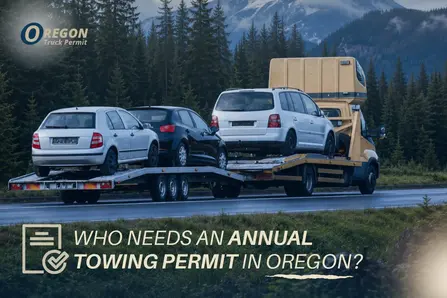
Who Needs Annual Towing Permit in Oregon?
 Published on: June 11, 2026
 Category:
Blog
Category:
Blog
Oregon trucking rules have a way of feeling simple at first… until you actually have to apply them on the road. Most towing operators figure this out pretty quickly. One job you’re fine; the next job suddenly pulls in permit questions you didn’t expect. Somewhere in that mix sits the annual towing permit in Oregon, and it’s one of those things people hear about but don’t always fully understand. Some assume every tow truck needs it. Others don’t think it applies to them at all. The reality is a bit more in-between. Let’s walk through it in a way that actually makes sense when you’re out working, not just reading regulations.
What Is an Annual Towing Permit in Oregon?
The annual towing permit in Oregon is basically there for towing and recovery operations that are on Oregon highways regularly, not just once in a while. Think of the jobs that don’t fit neatly into “normal trucking.” Accident recoveries, disabled vehicles, heavy-duty pulls, that kind of thing. The permit helps certain operators keep moving without stopping for a new approval every single time. The Oregon DMV Tow/Recovery Vehicle Program handles how these operations are classified and approved by the Oregon Department of Transportation DMV Tow/Recovery Vehicle Program.
But here’s where people sometimes get tripped up: this isn’t a free pass. It doesn’t cancel out other rules. You can still run into weight limits, axle rules, and all the usual Oregon permits for trucks while operating under it. It just sits alongside them, not above them.
Who Needs Annual Towing Permit?
This is the part most towing companies actually want a straight answer on, but Oregon doesn’t really give it in a single clean line. It usually comes down to what you’re doing and how your truck is set up. If you’re running light-duty towing in-town, staying within normal limits, you might never think about this permit at all. But once you get into heavier recovery work, highway calls, or equipment that pushes weight boundaries, the annual towing permit starts to matter more. Some operators end up needing it simply because their work is repetitive and commercial in nature. Others only touch towing occasionally and never deal with it. And sometimes, instead of (or alongside) this permit, an Oregon overweight permit becomes the real requirement depending on the load and configuration. That’s where things get messy because it’s not just about the truck; it’s about what the truck is doing at that exact moment.
How the Annual Towing Permit Fits With Other Oregon Permit Requirements
This is where a lot of confusion comes from. The annual towing permit doesn’t replace anything. It just sits inside a much bigger system that Oregon already has in place for trucking. If you’ve dealt with Oregon long enough, you’ve probably bumped into things like Oregon Weight Table 1, Oregon Weight Table 2, and Oregon Weight Table 4. They all play into how weight is legally calculated depending on your setup.
Then there’s the Oregon Bridge Law Chart, which is one of those rules that quietly changes your allowable weight depending on axle spacing. A lot of drivers don’t think about it until they suddenly have to. And on top of that, the Oregon Weight-Distance Permit still shows up for certain operations tied to mileage and taxation. So even if you’ve got an annual towing permit, you’re still working inside all of that. It doesn’t simplify Oregon; it just helps one specific type of operation fit into the system a bit more cleanly.
What Oregon Towing Companies Should Review Before Operating
Most towing companies don’t get in trouble because they “don’t care” about permits. It’s usually the opposite; things move fast, and someone assumes everything is covered. Before heading out, it’s worth slowing down just long enough to make sure the setup actually matches the job. That means looking at the truck, the load, the axle setup, and the route. Not just once, but for that specific call. A lot of operators check Oregon trucking online resources before dispatching just to avoid surprises later. It’s not about overthinking it; it’s about avoiding a roadside conversation that could have been prevented. Sometimes the job falls neatly under the Oregon permit truck structure. Other times it leans more toward an Oregon overweight permit situation or even additional requirements under the broader Oregon permit for trucks system. And occasionally, the Oregon weight distance permit comes into play too, depending on how the operation is classified. It really depends on the details of the day, not just the company’s general setup.
What Happens If Annual Towing Permit Is Not Obtained?
This is usually where things become very real, very quickly. If a towing operation needs an annual towing permit and doesn’t have it, it typically shows up during an inspection or roadside check. And at that point, it’s not really about explanations; it’s about compliance. The outcome can vary. Sometimes it’s a citation or fine. Other times the vehicle is held until the proper paperwork is in place. Either way, it slows everything down. And if other issues are involved weight limits, axle violations, or bridge law concerns, things can stack up fast. That’s why most experienced operators treat permit checks as part of the job itself, not something separate from it.
Conclusion
The annual towing permit in Oregon isn’t complicated on its own, but it sits inside a system that definitely is. Whether a carrier needs it depends on how the truck is being used, how often it’s operating in recovery situations, and how it fits into Oregon’s broader rules around weight, distance, and vehicle configuration. Once you understand how it connects with Oregon weight tables, bridge law rules, and the rest of the permit system, it becomes a lot less mysterious, just another piece of staying compliant on Oregon roads. And honestly, most towing companies figure this out the same way: not by reading rules first, but by running into situations where knowing them matters.